
The Best Way to Set Goals for Your Nutrition Strategy

Goal setting is often treated as an afterthought in nutrition. Most people start by deciding they want to “lose weight” or “eat healthier” — but without a clear structure behind those goals, progress tends to fade once motivation runs out.
Setting goals the right way is one of the most important steps in planning a sustainable nutrition strategy.
SMART Goals Aren’t Enough
You’ve probably heard of SMART goals — Specific, Measurable, Achievable, Relevant, and Time-bound. While it’s a useful framework for creating clarity, and keeping efforts directed, it is only a fragment of a proper goal setting process.
SMART goals don’t paint the goal in the context of your ultimate “why”. And they don’t allow you to properly visualize how one behavior can actually support multiple goals at the same time.
Building a Goal Hierarchy
A more complete approach is to build a goal hierarchy. This framework connects your goals across different levels of meaning, helping you align short-term actions with your long-term purpose.
There are three levels:
- Superordinate Goals — These are the “why” behind your efforts. They reflect your identity and values, such as “to feel confident and capable in my body” or “to be a healthy role model for my family.”
- Intermediate Goals — These are the outcomes you aim for that support your superordinate goal, such as “manage body weight” or “improve body composition.”
- Subordinate Goals — These are the concrete actions and habits that get you there, such as “meal prepping twice a week,” “training three times per week,” or “tracking protein intake.”
Each level reinforces the others. When your goals are organized this way, your habits have context, and your progress has more meaning.
One of the main benefits of the goal hierarchy is that it allows for flexibility. For example, if you sprain your ankle playing pickleball, perhaps your subordinate goal of “training three times per week” is off the table. But you can still support your intermediate goal of “manage body weight” by leveraging the subordinate goal of “meal prepping twice a week”.
Beyond flexibility, the goal hierarchy also gives you a specific illustration of the bi-directional relationship between your goals and how they can support each other.
How We Use This at Redesign Nutrition
At Redesign Nutrition, we help clients build their own goal hierarchies as part of our Lifestyle Redesign – Sustainable Weight Loss Course.
Rather than setting rigid deadlines or relying solely on short-term targets, we guide you through a process of connecting your daily habits to your long-term vision — so that your nutrition strategy actually fits into your life.
A clear structure makes all the difference. When your goals are organized, your effort becomes more focused, your progress becomes more consistent, and your habits finally start to feel like part of your lifestyle.
Sincerely,
Kevin Rogers, RDN, LD
Founder | Redesign Nutrition
Frequently asked questions
Are SMART goals enough for nutrition?
They are useful for clarity and direction, but they do not put goals in the context of your ultimate why or show how one behavior can support several goals at once.
What is a goal hierarchy?
A framework with three levels: superordinate goals reflecting your identity and values, intermediate goals that are the outcomes you want, and subordinate goals that are the concrete habits that get you there.
Can you give an example of a goal hierarchy?
Superordinate: "be a healthy role model for my family." Intermediate: "manage body weight." Subordinate: "meal prep twice a week" and "train three times per week."
Why does a goal hierarchy help?
It adds flexibility. If an injury stops you training, meal prepping can still support your weight goal, and your habits gain meaning from the bigger picture.
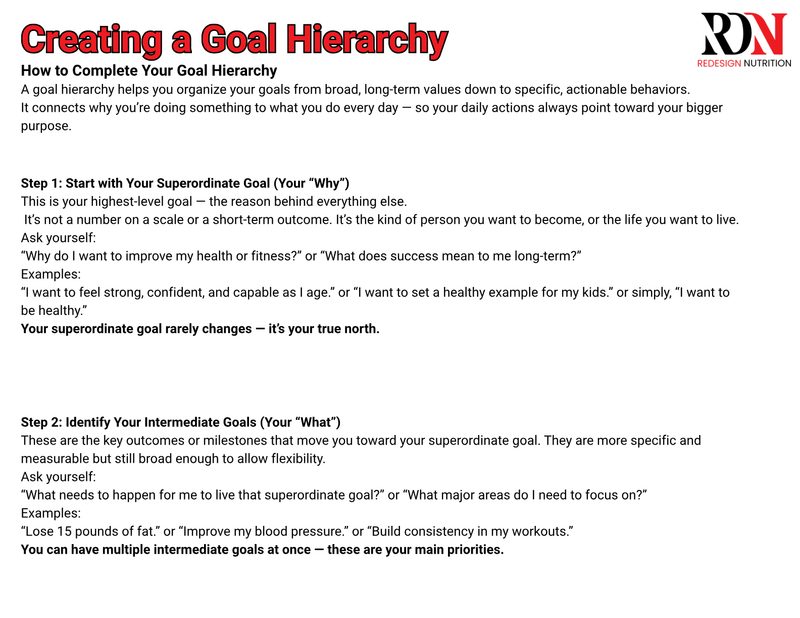
The Goal Hierarchy Worksheet
The goal-setting system used inside the Lifestyle Redesign course: connect your daily habits to the reason you started.
Instant download. You'll also get occasional nutrition tips; unsubscribe anytime. Privacy
Educational content written by a registered dietitian, not individual medical advice. See the medical disclaimer.