
How to Eat at Restaurants
Eating at restaurants can be challenging for anyone wanting to maintain a healthy diet. Portion sizes, hidden ingredients, and limited control over preparation methods often make it difficult to stick to nutrition goals. Yet, with the right skills and a bit of planning, dining out can be both enjoyable and health-supportive. As Dr. Walter Willett, Professor of Epidemiology and Nutrition at Harvard T.H. Chan School of Public Health, wisely states, “Healthy eating is not about strict limitations, but about making smart choices most of the time.”
Step 1: Restaurant Selection
Research menus online before you go. Opt for restaurants that offer healthier options, transparent nutrition info, or customizable meals. This step reduces the need to make decisions on the fly – which can be particularly difficult when there is social or situational pressure.
Step 2: Identify Lean Sources of Protein
Prioritize dishes with grilled, baked, or roasted lean meats, fish, tofu, or legumes. Avoid fried or heavily processed proteins. Protein will help with appetite management, and muscle maintenance (Westerterp-Plantenga et al., 2009), and we like muscle (see my previous blog article on protein.)
Step 3: Assess and Adjust Fat Sources
Restaurant meals often contain hidden fats. Identify items with cheese, creamy sauces, or added oils, and ask for modifications if needed. Choose steamed, roasted, or grilled sides over fried or buttery options. If you are uncertain about how an item is cooked, simply ask the staff, they are generally quite knowledgeable (it is important for them given many folks have food allergies).
Step 4: Adjust Carbohydrate Portions
Once protein and fat choices are made, adjust your carb portion. If you were able to manage a lean source of protein, with minimal added fats, then you probably have room for a moderate portion of healthy carbs. However, I generally recommend reducing the carbohydrate portion of meals at restaurants, simply because 99% of the places you go you will be getting much more fat than you bargained for – and most of it is built-in to the meal. This means your carb food is one of the few components you can actually adjust to help manage calories.
Step 5: Index on Leafy Greens
To keep meal volume reasonable, size up on your veggie portions (instead of your starchy carbs). This is generally a good way to keep portion sizes reasonable, and the meal filling overall. With one small caveat – if the veggies are cooking in oil, covered in dressing, marinaded in sauce, or fried in butter – probably do not do this, it would simply add substantially more fat and calories to your meal. Which leads us to our bonus tips.
Bonus Tips: Sauce on the Side
- Request sauces, gravies, curries, and dressings on the side (when possible). This is one of the best ways to manage calories in a meal. You can use enough for taste, without going overboard on calories.
- Save half (or more) for later, and add in some leafy greens and lean protein at home. This turns a very calorically-dense meal into a much more reasonable, and potentially balanced meal. And you get it eat it twice (or three times).
- Hydrate well. One of the most unfortunate things about eating out, that is almost unavoidable even at “health-forward” restaurants, is the sodium content. Almost every restaurant is going to add about your day’s worth of sodium in one meal. So be nice to your kidneys and hydrate well. (See my article How Much Sodium Should I Eat?).
Conclusion
Dining out can be complex, but with practice, you can build skills to make healthy choices in any setting. Nutrition skills are essential for navigating both restaurants and daily life. Just like any skill, eating healthfully at restaurants takes practice. And with practice you will improve your ability to eat out, and maintain healthy nutrition.
All the best,
Kevin Rogers, RDN, LD
Founder | Redesign Nutrition
References
Westerterp-Plantenga, M. S., Lemmens, S. G., & Westerterp, K. R. (2009). Dietary protein—its role in satiety, energetics, weight loss and health. British Journal of Nutrition, 101(6), 998–1006. https://doi.org/10.1017/S0007114508199012
Willett, W. (2021). Healthy eating: Making smart choices. Harvard Health Publishing. https://www.health.harvard.edu
Frequently asked questions
How can I eat healthy at a restaurant?
Pick the restaurant in advance, choose a lean protein, limit added fats, reduce the carb portion, add vegetables, and get sauces and dressings on the side.
Why reduce carbs at restaurants?
Most restaurant meals have more fat than you would expect, much of it built into the dish. The carb portion is one of the few parts you can easily adjust to manage calories.
Is it OK to ask how food is prepared?
Yes. Staff are generally knowledgeable about preparation, partly because so many diners have food allergies.
How much sodium is in a restaurant meal?
Often about a full day's worth in one meal, even at health-focused restaurants, so hydrate well.
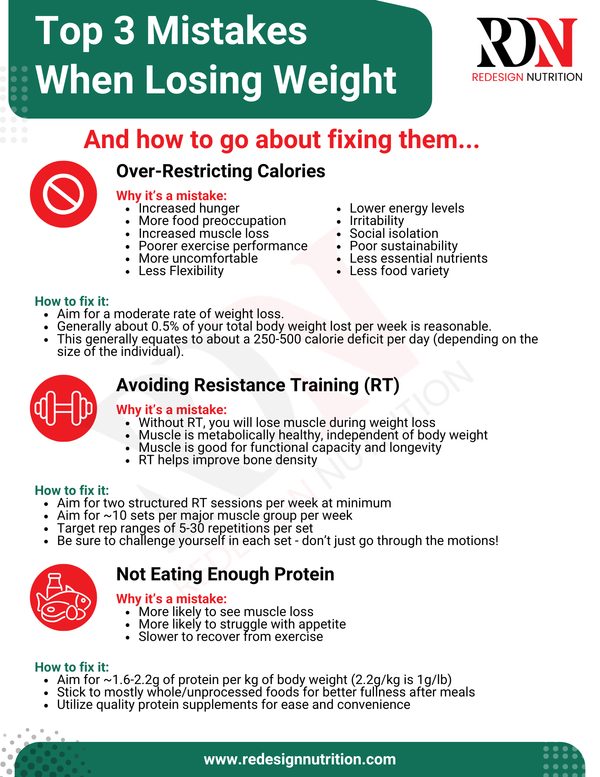
Top 3 Mistakes When Losing Weight
The three mistakes that quietly stall most fat loss, and exactly how to fix each one.
Instant download. You'll also get occasional nutrition tips; unsubscribe anytime. Privacy
Educational content written by a registered dietitian, not individual medical advice. See the medical disclaimer.